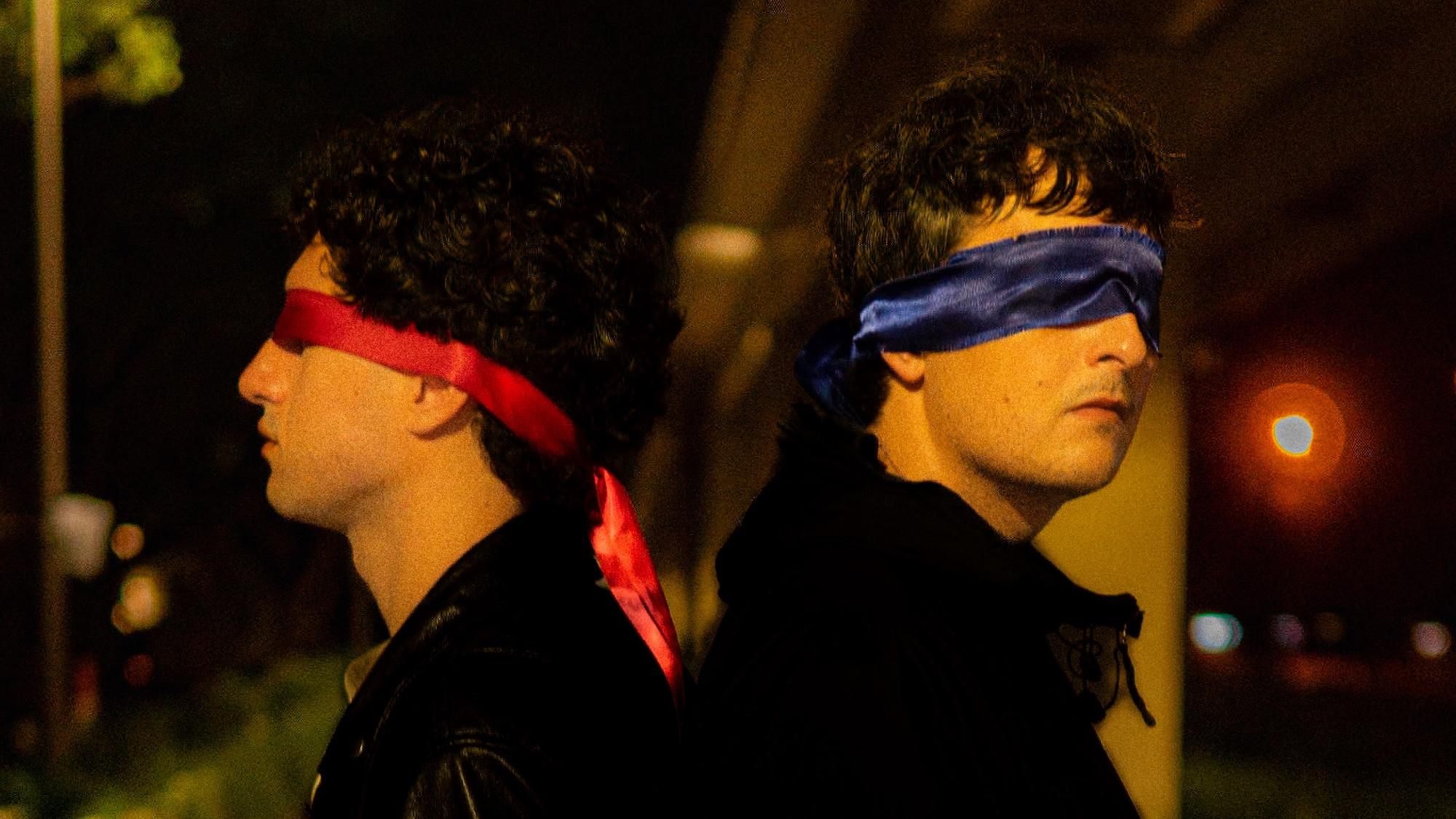
&NDRW and STV.OK?Y press photo.

Audio By Carbonatix
Of all the moments cited as dystopian prophecy in Philip K. Dick’s novel Do Android Dream of Electric Sheep? Few are as poignant as the scene in which the undercover android Pris talks with Detective Rick Deckard about how she read pre-colonial fiction—”stories written before space travel but about space travel” — to stave off the loneliness on Mars.
“How could there have been stories about space travel before…” Deckard begins to ask.
“The writers made it up,” Pris replies.
“Based on what?”
“On imagination.”
The irony of a sentient android explaining how imagination works to a human might’ve been somewhat lost on us in 1968, but in 2025, as we blithely hand over one creative medium after another to generative AI, it’s considerably more profound and harrowing.
In many ways Electric Glue — the fantastic new electronic rock EP from Miami-based producer/III Points veteran Bryan Andrew Medina (&NDRW) and vocalist Steven Delgado (STV.OK?Y) — feels like an essential, vivifying corrective to this drive toward generative dystopia: Yes, the sonic end takes post-Violator Depeche Mode and Pretty Hate Machine-era Nine Inch Nails then throws it in a blender with darkwave, post-punk, and Gesaffelstein-esque French electro. But more than a sound it is a collection of songs that augments, rather than subsumes, human creativity and ingenuity with its electronic elements.
“If you can’t set aside the technological element — the AI, the Splice samples, whatever—and still have something fundamentally real, something that you can place as an offering to a higher power or idea, then it’s not worth bringing into the world,” Medina says. “We’re living in an age of digital smoke and mirrors. Of art that is seen increasingly as just more content. To me, as a musician, I’m either wasting people’s time or I’m creating something that could potentially inspire them to feel and think on a deeper level. There’s really no middle ground anymore.”
“The music we make together leverages technology,” Delgado adds, “but more than anything it is an invitation to join us on a very human expedition.”
Many Paths, One (Musical) Truth
In the beginning, for Medina, there was Pink Floyd and Nine Inch Nails. But when he heard French electronic pioneers Daft Punk and Justice, his aesthetic was flipped on its head. His eventual partner in electro-crime Delgado, meanwhile, was a child blessed with a rock ‘n’ roll mom who raised him on a steady diet of seventies and eighties radio classics from the Eurythmics to Michael Jackson. Toward the tail end of high school, he read Jerry Hopikins and Danny Sugarman’s landmark biography of The Doors’ Jim Morrison No One Here Gets Out Alive, and he started exploring the more esoteric end of rock both as a listener and restless artist.
The two met through a mutual friend and, sensing almost immediately they might be kindred creative spirits despite these disparate influences, began performing impromptu jams at venues like Tea & Poets. “We’d just ride the flow like a wave,” Delgado says, “and it never failed to take us to cool, unexpected places.” Still, they drifted apart, living life, exploring different sounds and experiences. A couple of years ago, they rekindled their friendship and started jamming again. “We realized how special our creative partnership was,” Medina says. “You don’t understand that when you’re younger or until you try to recreate it with others.” Delgado joined Medina on tours throughout the U.S. and Europe as a photographer. When the spirit of the moment or the crowd called — and call both often did — he would put down the camera and sing.
Back home, the duo went back to the lab, inspired, pushing each other to grow and evolve — to synthesize Delgado’s rock spirit and Medina’s next-level versatility as a weaver of sonic tapestries. They also expanded their influences beyond music to books and films. (Ask Delgado about the musicality of Wim Wenders’ Paris, Texas or photography sometime if you want your perception of the world refracted and expanded.) “My favorite things all have layers, regardless of medium,” Medina says. “That’s where you find the physicality of it, the realness. A lot of these elements might forever remain a mystery to most listeners, but it’s the foundation. It’s essential.”
The standards are high: Medina demoed a couple hundred tracks but only pursued maybe twenty for completion.
“If it doesn’t make us tear up, if we don’t cry at some point writing a song, it’s probably not going to make the cut,” Delgado says. If they strayed too far from that ideal, the phone were put away and they’d go into the real world, seeking prompts from the aforementioned higher power, not Chat-GPT. “We wanted it to be real,” Delgado says. “However long it took, whatever experiences we needed to go through, it had to be real in an undeniable, heartbreaking way or we were both willing to walk away.”
That will to vulnerability is a game-changer in Medina’s mind. “I only want to release music with people who care,” he says. “And Steve does. He sings from the soul. He’s able to completely release his ego and absolutely lose himself and find the purest expression possible in that moment. He’s a great singer with a lot of range, but he’s guided by something bigger, and that’s what’s really special about his performance.”
The resulting EP, Electric Glue, is ostensibly about corruption — in the music industry, but also in the world that that industry mirrors — yet, in making good on its promise to “burn genre maps and reclaim a grittier vision of the dancefloor,” sultry, dusky songs like “Reaching 4 a.m.” and “Alive Again” show a path to resuscitation of our more harmonious, generous instincts and, ultimately, healing.
“I wanted the lyrics to feel like a mirror, uncomfortable but familiar,” Delgado says. “The beauty of it is in the distortion.”
Magic City Magic
Medina and Delgado were both born and raised in Miami — and despite their music being embryonically global, it shows. “We live in a wild city and the music reflects that,” Delgado says. “There’s a freedom of expression we’ve always enjoyed here. Maybe not everyone is their true selves in Miami, but the option exists.”
It’s also a beachhead. “From the beginning,” Delgado says, “we’ve been about building community and working with local artists to help them become the best, most fully actualized version of themselves.” This can be seen in the underground event series Watchtower, which Medina and Delgado curate through Ban All Music Records.
And while the pair have plenty of new music loaded in their respective chambers — Delgado plays New Times a ridiculously good acoustic EP that falls between Leonard Cohen and Tom Waits; Medina is working with a slew of collaborators — they’re devoted, separately and together, to being judicious about next moves. “We want to make sure whatever we do next really hits,” Delgado says.