
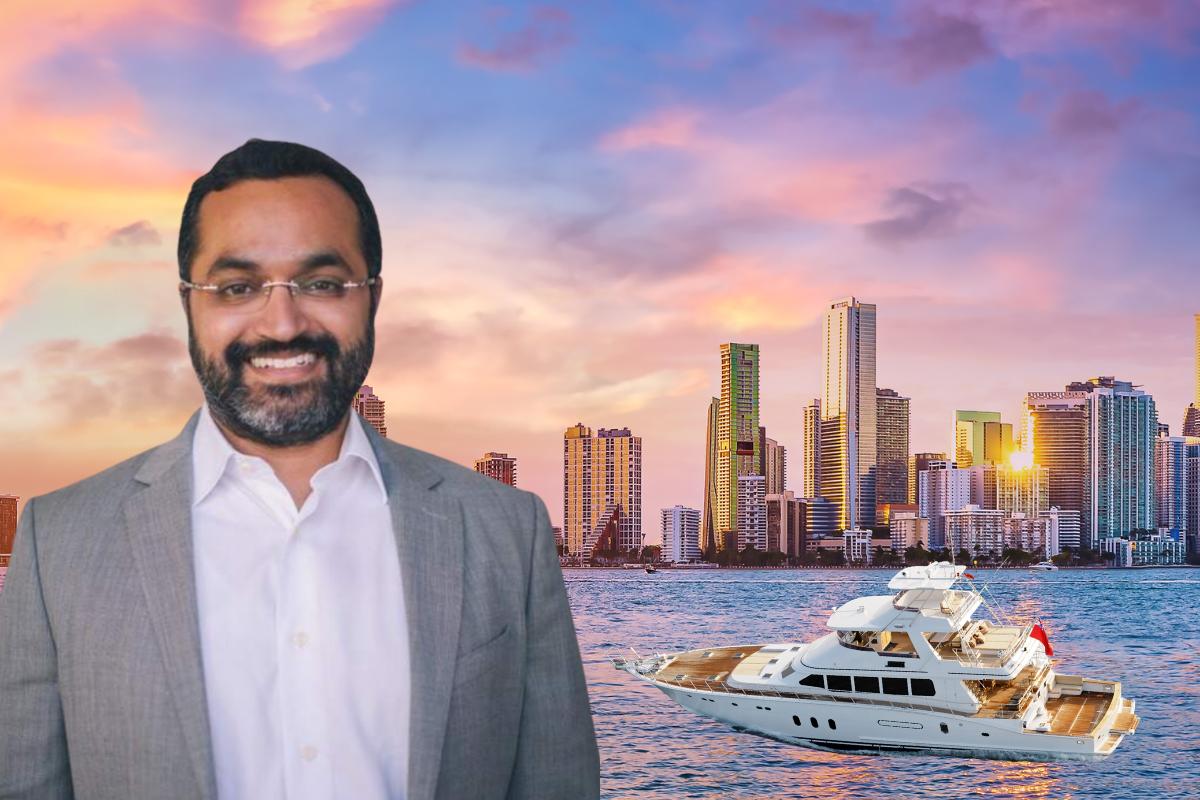
Rishi Kapoor photo via NBC6; Miami New Times illustration

Audio By Carbonatix
For three years, Rishi Kapoor was the easiest kind of Miami story to write: a University of Miami grad in a leased McLaren, a 68-foot Princess yacht, an 18-karat gold Rolex Daytona, a secluded Coral Gables mansion bought with other people’s money. That story has been told. A smaller one, buried in the bank-fraud counts of his federal indictment, is more revealing — and it fits on a single statement.
Kapoor, 42, ran Location Ventures, a Coral Gables development company that raised roughly $89 million from more than 50 investors for condo and mixed-use projects across Coral Gables, Coconut Grove, and Miami Beach. Most were never built. The firm collapsed in 2023; the U.S. Securities and Exchange Commission (SEC) sued, a court-appointed receiver took over what was left, and federal prosecutors indicted him on 37 counts of fraud, money laundering, and tax crimes. Last month, he pleaded guilty to two of them and now awaits sentencing. Investors are owed tens of millions they are unlikely to fully recover.
When he needed banks to lend him money, prosecutors allege, Kapoor didn’t build elaborate shell companies or forge signatures. He added a digit. In December 2022, the indictment says, he submitted a statement for his personal account showing a balance of $9,148,426.44; the real figure was $148,426.44 — a “9” added to the front. He ran the same play in February 2023, prosecutors allege: $9,100,424.67 on paper, $100,424.67 in fact. Months earlier, a $356,806.23 balance had become $2,356,806.23 with a “2.” On one personal financial statement, the indictment says, he claimed $3.1 million in a checking account that held less than $25,000.
Crude as they were, prosecutors say the alterations worked. The indictment ties the doctored documents to a $5 million line of credit for Location Ventures and a $4.2 million personal loan from a second bank — the loan that financed the very yacht that made the headlines. Two FDIC-insured banks, one in Massachusetts and one in Texas, ran their underwriting on numbers a careful reader could have unwound with a calculator.
Kapoor has not admitted any of that. His guilty plea covered one count of money laundering — the $820,559 down payment on the yacht — and one count of conspiring to dodge payroll taxes; the bank-fraud counts were not part of it. His lawyers have directly contested the allegation regarding the bank statement. In an April court filing, they argued it “is not known” whether Kapoor prepared or submitted the altered statement, and that it was not used to obtain the line of credit, which had been issued earlier. They conceded that the inflated statement was later “used to secure a loan,” but argued that the bank ultimately suffered no loss because it foreclosed on the yacht and, in their view, profited from interest — a point the government has not conceded.
Reached for comment, the U.S. Attorney’s Office for the Southern District of Florida declined.
The Kapoor story has mostly been framed as a Miami morality play about yachts, watches, mayors, and vanished condos. But the bank-fraud counts suggest something more unsettling: the alleged deception was crude, and the institutions around him still let it through.
The temptation is to read the rest as a man improvising out of a cash crunch. The court record argues otherwise. Kapoor had been here before. The indictment notes that years earlier, at a company he ran before Location Ventures, he withheld his employees’ payroll taxes, failed to remit them to the IRS, and was personally notified by the agency. He also failed to pay his own 2015 and 2016 income-tax liabilities in a timely manner, drew an IRS lien, and didn’t clear it until June 2019 — the same window in which he was scaling Location Ventures into a near-nine-figure operation.
His own emails, quoted in the indictment, show the pattern wasn’t oversight. In January 2019, a finance officer flagged overdue payroll taxes — “At some point we need to start paying these!” Kapoor’s reply: “Understood. Maybe after VV and URBIN are all rolling fee wise?” In April 2021, after a controller warned the unpaid liabilities had passed $600,000 and urged “a plan of attack,” they decided not to pay. More than $1.3 million in payroll-tax funds — including taxes withheld from employees and employer FICA contributions — went unpaid while corporate money was used for bonuses, commissions, and distributions, some of it to Kapoor himself — conduct he did admit to in his plea. The U.S. Attorney called it stealing from his own employees.
The deception ran on two tracks. Kapoor admitted in his plea that, with his knowledge and direction, false entries were made in the company’s QuickBooks to make it look as though Location Ventures had paid payroll taxes it hadn’t — and that he then represented on the income statements and balance sheets handed to investors, that those tax obligations were satisfied, knowing they were not. When scrutiny got close, the indictment alleges, Kapoor cleaned up the optics.
After a major investor questioned payments he’d taken, he sent $600,000 in invoices to his own construction contractor for “business developing consulting services” he never performed, paid the contractor from an URBIN Miami Beach account, then had the contractor wire the $600,000 back to his personal account — money he spent on his Cocoplum mortgage. He refused to fill out the tax form that would have documented it.
Kapoor is scheduled for sentencing on Aug. 27 and faces at least a decade in prison and some $70 million in restitution that he is unlikely ever to pay. He told the court he’d make repayment his “life’s work.”
A lawyer for Kapoor declined to comment when reached by New Times via email.
The same deference followed him beyond the banks. While Location Ventures sought City Hall approvals, its URBIN affiliate paid then-Miami Mayor Francis Suarez more than $200,000 in consulting fees; Suarez has denied wrongdoing and has not been charged. (Leaving office, he drew a separate internal-affairs inquiry over Rolexes he allegedly gave his police detail.)
Suarez had not returned New Times’ request for comment via email or Instagram by the time of this publication.
In Coral Gables, Kapoor’s business intersected with Mayor Vince Lago through a storefront lease and a brokerage-linked commission, though Lago recused himself from the relevant votes and has also not been charged.
The criminal case raises an interesting question: how many people had to accept Kapoor’s paperwork, pitches, and proximity before the collapse became unavoidable?