
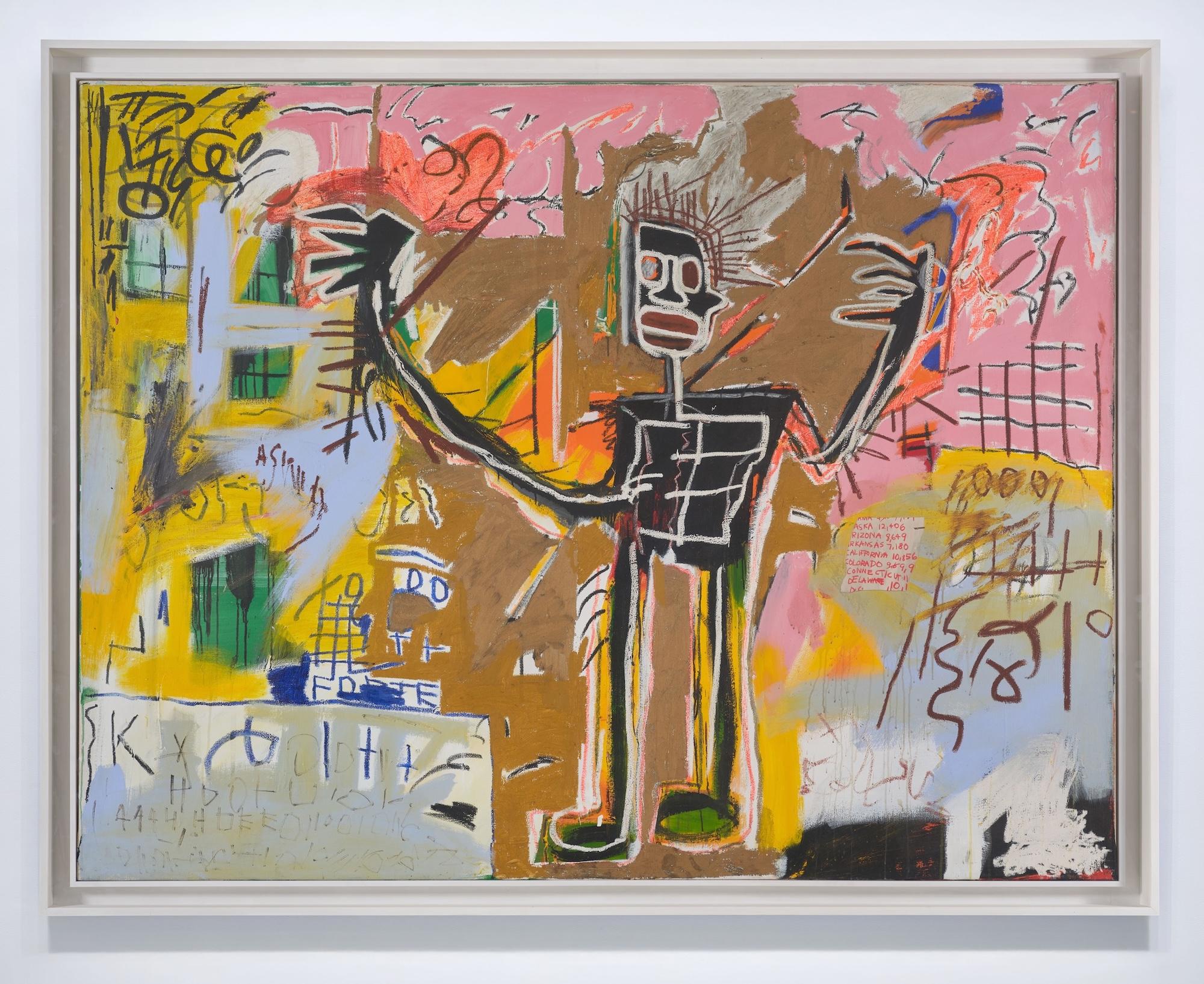
Kenneth C. Griffin Collection. Artwork © Estate of Jean-Michel Basquiat.
Licensed by Artestar, New York.

Audio By Carbonatix
Some artists become famous. A select few become symbols. Jean-Michel Basquiat became both.
More than three decades after his death at age 27, Basquiat’s crown motif remains one of the most recognizable images in contemporary culture. His paintings command nine-figure prices at auction, appear on luxury fashion collaborations, inspire musicians and filmmakers, and continue to attract a level of celebrity fascination usually reserved for rock stars.
Now, Miami audiences will have a rare opportunity to see beyond the mythology.
“Basquiat: Figures, Signs, Symbols” at Pérez Art Museum Miami brings together nine paintings and one sculpture from the Kenneth C. Griffin Collection, creating one of the most significant presentations of the artist’s work ever mounted in South Florida. Timed to coincide with Miami’s influx of international visitors during the FIFA World Cup, the exhibition offers a chance to stand before Basquiat’s work and experience its complexity firsthand.
For an artist whose imagery has been endlessly reproduced on posters, T-shirts, and Instagram feeds, seeing the real thing remains transformative.
The exhibition focuses on several of Basquiat’s central concerns: portraiture, language, anatomy, race, power, history, and the layered visual vocabulary that made him one of the most influential artists of the late 20th century. Included are major works such as “Untitled” (1982), featuring the skull-like heads that became one of his signature motifs; “In Italian” (1983), a densely packed composition that functions simultaneously as portrait, diary, historical reference, and linguistic puzzle; and “Pez Dispenser” (1984), his playful yet incisive reimagining of a familiar consumer object.
What makes the exhibition especially compelling is that it arrives during a period when Basquiat’s market value often threatens to overshadow his artistic achievement.
Trophies for billionaires
Today, Basquiat occupies a unique position in the cultural imagination. He is simultaneously a street artist, an art-world revolutionary, a Black cultural icon, a fashion reference point, and an investment asset. His paintings have become trophies for collectors ranging from musicians to billionaires. (The Kenneth C. Griffin Collection’s namesake is reportedly worth $51.5 billion, making him one of the richest men on the planet.)
Jay-Z and Beyoncé own several Basquiat works and famously posed beside “Equals Pi” for a Tiffany & Co. campaign. Kim Kardashian owns the 1982 painting “Both Poles.” Alicia Keys and Swizz Beatz have built a substantial collection through their Dean Collection initiative, while Madonna began acquiring Basquiat’s work when the artist was still emerging in New York’s downtown scene. Lenny Kravitz, Elton John, and Leonardo DiCaprio are reportedly collectors, too.
Debbie Harry of Blondie was ahead of them all: She purchased one of Basquiat’s earliest paintings, “Cadillac Moon,” for just $200 in 1981. Today, that anecdote feels almost impossible to comprehend.
The ultimate symbol of Basquiat’s ascent came in 2017, when Japanese billionaire Yusaku Maezawa paid $110.5 million for the artist’s 1982 skull painting “Untitled” at Sotheby’s. At the time, the purchase set the record for an American artist at auction. The sale transformed Basquiat from a beloved contemporary artist into a global financial phenomenon.
Yet focusing exclusively on auction prices misses the point.
Resonating in Miami
Basquiat’s enduring power lies not in his market value but in the urgency of his ideas.
Born in Brooklyn to a Haitian father and Puerto Rican mother, Basquiat developed a visual language that drew from an astonishing range of influences: jazz, hip-hop, anatomy textbooks, African diasporic history, Gray’s Anatomy, comic books, sports, poetry, and art history. His canvases feel less like traditional paintings than collisions of information, where fragments of language, symbols, diagrams, and images compete for attention.
The result is work that remains startlingly contemporary. Long before discussions about representation and cultural identity became mainstream topics in museums, Basquiat was exploring how Black bodies, Black histories, and Black achievement were represented — or erased — within Western culture. His paintings challenged viewers to confront questions about race, power, labor, celebrity, and historical memory.
Those themes resonate strongly in Miami, a city shaped by migration, diaspora, and cultural hybridity.
PAMM Director Franklin Sirmans, who co-curated the exhibition, has spent much of his career championing Basquiat’s legacy. He first encountered the artist’s work as a young New Yorker and later contributed to major exhibitions that helped establish Basquiat as one of the defining artists of his generation.
That long relationship with the artist informs the exhibition’s approach. Rather than emphasizing Basquiat as a pop-cultural icon or auction-house superstar, “Figures, Signs, Symbols” presents him as a rigorous painter and intellectual thinker whose work rewards close attention.
The timing feels especially appropriate.
Miami has evolved into one of the world’s most influential contemporary art capitals, attracting collectors, galleries, artists, and institutions from across the globe. Yet the city also maintains deep Caribbean and Latin American connections that make Basquiat’s perspective particularly relevant here.
His work emerged from the intersections of cultures, languages, and identities. It reflects experiences familiar to many Miami residents —the feeling of existing between worlds, navigating multiple histories, and creating new forms of expression from overlapping traditions.
That context gives the exhibition a resonance that extends beyond the museum walls.
A rare opportunity
Visitors may arrive expecting the Basquiat they know from headlines and auction records. What they’ll encounter instead is something richer: an artist wrestling with history, language, religion, race, and the mechanics of image-making itself.
The exhibition also includes video footage of Basquiat discussing his work, providing a rare opportunity to hear directly from the artist in his own words.
And perhaps that’s the greatest achievement of “Basquiat: Figures, Signs, Symbols.”
For all the celebrity collectors, record-breaking sales, and cultural cachet attached to his name, Basquiat’s paintings remain remarkably human. They are restless, searching, brilliant, angry, funny, vulnerable, and endlessly curious. They ask viewers to decode, question, and reconsider what they think they know.
In a culture increasingly driven by quick impressions and abbreviated attention spans, Basquiat’s work demands something different: It demands that we slow down.
This summer, even amid the chaos of the World Cup, Miami gets the chance to do exactly that.
“Basquiat: Figures, Signs, and Symbols.” On view through June 6, 2027, at Pérez Art Museum Miami, 1103 Biscayne Blvd., Miami; 305-375-3000; pamm.org.Museum admission costs $0 to $18.